Sunday, January 28, 2018

National Civil Rights Museum, Memphis

A trip to the National Civil Rights Museum in Memphis, highly recommended by my friend Tait Danielson-Castillo as a must, turned out to be the absolute highlight of my trip there! The museum itself is located in the Lorraine Hotel. If that name sounds familiar, it is because that is where Dr. Martin Luther King was assassinated in 1968.

When you first come in to the museum, you are treated to an extremely large and busy sculpture called “Movement to Overcome” in the lobby that is worth seeing. It is hard to describe, but once seen will never be forgotten. Michael Pavlovsky created a 13-foot-by-26-foot, 7,000-pound bronze sculpture that represents a collection of human figures rising from and making their way on both sides of a narrow divide. The author stated that, "It’s about the anonymous individuals that we know nothing about now that lived the civil rights struggle and participated in it. They are forgotten. But the hundreds of images of human figures on that sculpture represent those anonymous individuals."

You buy your ticket and are ushered into a large circular room that contains sculptures and curated descriptions of the timeline of American slavery. There is enough time to see most of it before they open the doors to the theater for a short film clip of the museum. After this film clip, you are free to browse thru the museum at your own pace.

There are many, many exhibits in this very well-laid out and curated museum. I will highlight the ones that spoke to me. The first was the Montgomery bus boycott. The exhibit is called "The Year They Walked."

On December 1, 1955 Rosa Parks refused to give up her seat on a bus in Montgomery, AL and sparked the American Civil Rights movement of the 20th century. The U.S. Supreme Court ultimately ordered Montgomery to integrate its bus system, and one of the leaders of the boycott, a young pastor named Martin Luther King Jr., emerged as a prominent leader of the American civil rights movement. Although Parks has sometimes been depicted as a woman with no history of civil rights activism at the time of her arrest, she and her husband Raymond were, in fact, active in the local chapter of the National Association for the Advancement of Colored People (NAACP), and Parks served as its secretary.

The Women’s Political Council (WPC), a group of black women working for civil rights, began circulating flyers calling for a boycott of the bus system on December 5, the day Parks would be tried in municipal court. Approximately 40,000 African-American bus riders—the majority of the city’s bus riders—boycotted the system the next day, December 5. That afternoon, black leaders met to form the Montgomery Improvement Association (MIA). The group elected Martin Luther King Jr., the 26-year-old-pastor of Montgomery’s Dexter Avenue Baptist Church, as its president, and decided to continue the boycott until the city met its demands. On June 5, 1956, a Montgomery federal court ruled that any law requiring racially segregated seating on buses violated the 14th Amendment to the U.S. Constitution.

The exhibit contains a Montgomery city bus that visitors can enter and sit down on the bus with a life-size sculpture of Rosa Parks. There is an audio program that explains the bus boycott and the roles of Rosa Parks and young Rev. Martin Luther King. Outside the bus are life-size sculptures of the anonymous Black women who walked to and from work for a year to earn the right to sit anywhere on the bus they desired. In other words, they walked to work for a year to gain human dignity and set in motion a Civil Rights movement that would grow beyond their wildest dreams and thrust both Rosa Parks and Martin Luther King into the headlines and the history books.

Human rights stuggles do not appear as if by magic in one stroke of a woman who will not give up her seat on the bus. In February of 1956, a young man named Bayard Rustin arrived in Montgomery to help Dr. King and Rosa Parks with this nacent movement. Rustin had organized the first Freedom Ride in 1947 - a ride called the Journey to Reconciliation taken by 8 Black men and 8 White men from D.C. to Louisville to take action against discrimination on interstate buses. Bayard brought with him masterful organizing and strategic capabilities that grew the movement into a national force, and a firm commitment to Gandhi's nonviolent civil disobedience. Never heard of him? Perhaps because he was a gay man - a Black gay man.

Wyatt Tee Walker, a Freedom Rider who was arrested more than 17 times for challenging segregation in the South, had become executive director of the Southern Christian Leadership Conference in 1961 after King called to recruit him. Walker was the most famous man that no one ever knew during the Civil Rights campaigns. The local police were always searching for him because he arrived in town before every major Martin Luther King led march to identify, measure, and target every step along the way and devise the march strategy, but they could not arrest him because they did not know what he looked like. In October of 1967, Walker was arrested with Dr. King and spent 3 days in the Birmingham jail. Walker snuck a camera into the jail cell taped to his leg and took this iconic photo of King which is displayed at the museum. What is less known is that King snapped a photo of the elusive and rarely photographed W.T. Walker that same day. This was four years after King's famous "Letter from a Birmingham Jail" was written.

On 1 February 1968, two Memphis garbage collectors, Echol Cole and Robert Walker, were crushed to death by a malfunctioning truck. Twelve days later, 1,300 black men from the Memphis Department of Public Works went on strike. Sanitation workers, led by garbage-collector-turned-union-organizer, T. O. Jones, and supported by AFSCME President Jerry Wurf, demanded recognition of their union, better safety standards, and a decent wage. Within a week, the local branch of the National Association for the Advancement of Colored People (NAACP) passed a resolution supporting the strike. The following day, after police used mace and tear gas against nonviolent demonstrators, Memphis’s black community was galvanized. Meeting in a church basement on 24 February, 150 local ministers formed Community on the Move for Equality (COME). COME committed to the use nonviolent civil disobedience to fill Memphis’s jails and bring attention to the plight of the sanitation workers.

By the beginning of March of 1968, local high school and college students, nearly a quarter of them white, were participating alongside garbage workers in daily "I Am a Man" marches; and over one hundred people, including several ministers, had been arrested. National civil rights leaders, including Roy Wilkins and Bayard Rustin, came to rally the sanitation workers. King himself arrived on 18 March to address a crowd of about 25,000 – the largest indoor gathering the civil rights movement had ever seen. Following this speech, the Southern Christian Leaderships Conference’s (SCLC) James Bevel and Ralph Abernathy remained to help organize the protest and work stoppage. Despite some violence from a group supporting the protestors, Dr. King on 3 April was persuaded to speak to a crowd of dedicated sanitation workers who had braved another snow storm to hear him, giving them his famous "I Have Been to the Mountaintop" speech. King told them that they could not give up now and preached about his own mortality, telling the group, “Like anybody, I would like to live a long life--longevity has its place. But I'm not concerned about that now… I've seen the Promised Land. I may not get there with you. But I want you to know tonight that we, as a people, will get to the Promised Land”

At 6:01 pm on April 4, 1968, as Dr. King stepped out on the balcony outside Room 306 of the Lorraine Hotel in Memphis, he was shot by James Earl Ray with a high powered rifle from the apartment building across the street. Dr. King had been preparing for an evening event in support of the garbage workers' strike. Andrew Young, Ralph Abernathy, Jesse Jackson, Hosea Williams, William Campbell, and musician Ben Branch were with him that evening. King was taken to St. Joseph's Hospital where he was pronounced dead at 7:05 pm, never having regained consciousness.

The museum tour ends at a very average 1960s-era motel room identified as Room 306. I thought it was a re-creation, as many of the items in the museum are. But no. This is the actual Room 306 that Dr. Martin Luther King was staying in that night and the room they pulled him back into after he was shot. It took my breath away. I was not expecting to have history thrust in my face quite so starkly. This was a powerful exhibit, but so exquisitely simple. It is difficult to describe all the feelings it brings up. The last photo is of the now-famous balcony. The wreath is a permanent fixture (probably not always done up in Christmas design, but a wreath is always there), as are the historically accurate 1960s era cars.

Wednesday, January 24, 2018

Beale Street!!!!

Day 2 started off with a foray to: (1) buy parts for my camper that I broke the day before, (2) check in at the Memphis Visitor Information Center, (3) get breakfast - which proved to be more difficult than I imagined, (4) do my laundry, and (5) take a nap to make up for the total lack of sleep on the first night in Memphis due to my broken camper furnace.

In the evening took the Graceland Hotel shuttle into downtown Memphis. They offered a drop-off and pick-up on Beale Street. The shuttles come once per hour. I was very happy to not have to park downtown. I did take some photos of the hotel interior, which was done up in kind of 1950s era Las Vegas style, but unfortunately my camera chose not to save them. It does that sometimes. The shuttle was comfortable, clean, and the driver was outgoing - good experience.

I took my friend Tait Danielson-Castillo's suggestion to eat at Flying Fish. It is a fast-casual Cajun seafood restaurant that has its very own special vibe. I did enjoy the people watching - and the food! Excellent recommendation Tait!


I walked down 2nd Street to Beale. Tried to stop at one of the many music museums downtown, but it was closed on a Saturday night, which seemed a little strange to me. Beale Street itself is blocked off by the police on both ends of a three block stretch, so the entire street and sidewalks are kind of alive with pedestrians and street performers during the evening hours. It reminded me a lot of the French Quarter in New Orleans. Went to BB King's Blues Club first. Loved the music and the people watching. There was a woman with joie de vivre to spare at the table next to me who kind of drew me into her date with her husband. She made the experience a lot of fun. Travel karma. I stayed long enough to hear three bands (each one on stage for a little less than one hour). They were all fantastic, but all very different. And they were extremely serious about their Blues music.

I walked down Beale Street, doing some window shopping, watching the street performers, and scoping out the other music clubs. Stopped at Rum Boogie Cafe next. At first, I was a little disappointed that a rock 'n roll band was playing that night. But their musicianship won me over. However, the lack of sleep on Thursday night caught up with me and I kind of nodded off at my table. The waitress woke me up, so I decided it was time to head for home.

I did enjoy Beale Street. I can see why people who are just looking for some good music might prefer an atmosphere that isn't so carnival-like, but it was great for a single person who wants to anonymously enjoy the club vibe. I returned to the shuttle pick-up spot, and was entertained for about 20 minutes by a private limousine shuttle and its passengers. The entertainment was not intended; it was just pure great people watching -- and they were some unintentionally hilarious people.

Sunday, January 14, 2018

Tour of Elvis' Graceland Mansion

Day 1 started out with driving to a Target store to buy a small electric heater for the camper. Heat at last. One of those things you take for granted until you can't get it for more than 3 weeks. My camping skills were tested!

Then decided to walk next door to take the tour of Graceland. There was a handy opening in the chain link fence that separated the RV Park from the Graceland entertainment complex. So, I took a couple of photos, bought my ticket, and got on the bus to drive us across the street to the mansion. You cannot drive up to the mansion; the only vehicles allowed in the musical note gates are the buses.

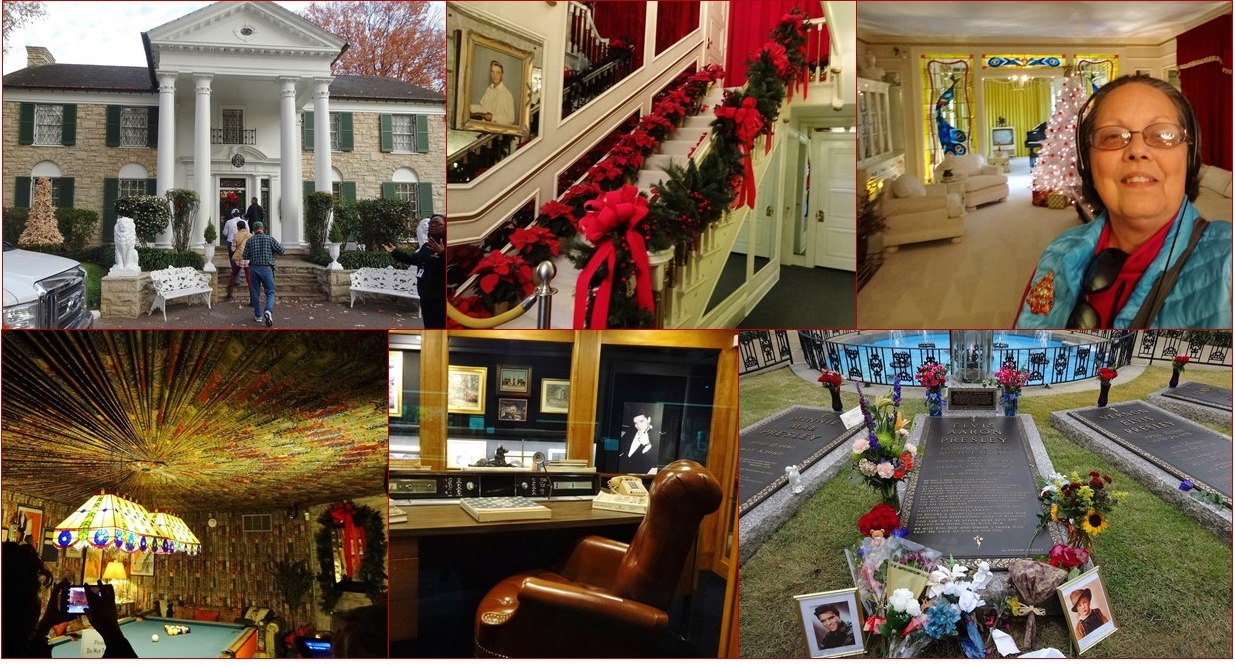
We entered the mansion and followed along with the audio tape at our own pace. It was decorated for Christmas, which was a bonus. The famous peacock stained glass windows in the living room were created by Lauxhuff Designs of Memphis. They also made the stained glass light fixtures above the billiard table. Elvis was apparently a fan of billiards. There is a tear in the table fabric and no one seems to know the guilty party. There are a few bizarre rooms there, including a TV viewing room with 3 television sets. Reportedly, Elvis heard that Pres. Lyndon Johnson had 3 television sets so he could watch all three major news networks at once. Elvis used his to watch football on all three major networks. The upstairs is off limits, but the curators have brought his entire home office down into the tunnel below the mansion (called the Trophy Building) and recreated it behind glass. The collection was surprisingly well curated.

The last photo is Elvis' grave (along with those of his two parents and grandmother) in what he called his Meditation Garden, fashioned after an ancient Greek garden complete with an Italian statue. It was built by Bernard Grenadier in the mid-60s at Elvis' request. The brick wall behind the Grecian columns is inlaid with primitive, hand-made Spanish stained glass from the 1800s.


I took the bus back across the street to the Elvis Presley Enterprises museum. This huge auditorium style building houses all his career artifacts: records, musical instruments, costumes, posters, etc. His daughter Lisa Marie Presley only owns 15% of Elvis Presley Enterprises, but she is the sole owner of Graceland mansion itself. The photo mashup up below shows (clockwise) (1) a poster of photos from Sun Records, the Memphis recording company that produced most of Elvis' recordings, (2) his favorite acoustic guitar, (3) his wall of records, (4) the logo on the door - I just like the simplicity of it, and (5) his gold and platinum records. I was prepared to be underwhelmed by this museum, but actually found it really interesting. I especially enjoyed the European posters. Of course, they had about 5 shops full of memorabilia for tourists with too much cash in their pockets.


Since I didn't get a very good sleep - see cold night in the camper in previous post - I decided to skip Beale Street the first night and head over there the following evening. I went to sleep early and my new, tiny electric heater kept me toasty warm.

Sunday, December 31, 2017

Picking Up Memphis, 2017

When I went on my Great National Retirement Tour in 2016, I was not able to squeeze Memphis into the itinerary. But I did want to experience Beale Street. So when my college room-mate Jane Gramoli invited me to come stay with her the next time I was in Louisiana, and since Memphis is sort of between Shreveport and Bloomington, Illinois, I decided to pick up a few days in Memphis.

My first adventure was finding a camping spot. There were three (3) RV campgrounds in the city - one far outside the urban ring road, and two on Elvis Presley Boulevard not far from downtown. I looked up the customer reviews and everyone agreed that the Graceland RV Park (yes, it is owned by Elvis Presley Enterprises) was the better of the two campgrounds. So, I made a reservation there.


I also contacted my friend Tait Danielson-Castillo who lived in Memphis for a while to get suggestions on places to visit and places to eat in Memphis. Tait gave me a list of wonderful suggestions. I'm afraid I did not have time to go to all of them, but the ones I did get to in my 2-day stay were stellar. Thanks Tait.

I got a late start leaving Shreveport because Brent and I had a regular on-going soap opera trying to open a savings account for DJ and opening up a safe deposit box for him at a credit union there. We finally got the safe deposit box settled on the last day I was there. DJ still does not have his "bank." I said all that to say that I got to Memphis late; almost midnight. I could not find my RV Park. I drove up and down on Elvis Presley Boulevard many times searching for it. I finally found a campground, drove in, and set up my camper for the night. Another night without heat since, after all the trouble I had in Shreveport with bad electrical connections, apparently the furnace also did not work. In the morning, I realized I was in the wrong RV Park. So, had to take down the pop-up, drive about a mile down the road, and set it up all over again. And yes, Graceland is a MUCH better campground than the other park was. And yes, it is also right across the street from Elvis' Graceland mansion.

This RV Park had very nice bathrooms with full shower facilities, a very clean laundry facility, and secuity guards to keep any cars without parking stickers out of the campground. They also had a "family" relationship with the Graceland hotel across the street so we could get shuttle rides to and from major Memphis attractions, including Beale Street from their lobby. I would recommend the park. My spot was on Shook Up Lane - and yes, all the driveways were labelled with Elvis' song titles.

Tuesday, June 14, 2016

Old Time Photo from Tombstone

Remember back in February when I said that I would post up the old time photo that Colleen, Carol and I took in Tombstone as soon as I got someplace where I could scan the print photo? Well, I finally did get that photo scanned and here it is! Don't we look like a trio of treacherous characters!

Thursday, June 9, 2016

Pat's Great National Retirement Tour by the Numbers

May 18, 2016:

I was on the road for 96 Days from January 15 thru April 19, 2016

Traveled 10,543 miles

Spent roughly $1,110 on gas, oil, windshield washer fluid, two oil changes, and a headlight replacement while on my trip. This does not include the costs for getting hit in Brent’s parking lot in the middle of the night by a hit and run driver. That could just as easily have happened if I had stayed home. My mother always kept track of all the gasoline we used on our family trips, and it seemed like a nod to tradition to do it for this trip too. And, in case you are wondering, I really do love Love's!

Stayed in 10 states, did some sightseeing, and visited friends and family: New Mexico, California, Arizona, Texas, Louisiana, Florida, South Carolina, North Carolina, Tennessee, and Illinois

Traveled thru parts of another 9 states: Iowa, Missouri, Kansas, Oklahoma, Mississippi, Alabama, Georgia, Kentucky, and Wisconsin (sometimes very small parts).

Most of my travel happened on Interstate 10, which stretches from Los Angeles, California to Jacksonville, Florida. I drove all but two segments of that road all across the USA (skipping one small segment from L.A. to Palm Springs and one larger segment from San Antonio, Texas to Baton Rouge, Louisiana). I have, however, on another trip in another year driven the segment between Lafayette, Louisiana and San Antonio, Texas.


Spent 28 nights sleeping in my Palomino camper on this tour, bringing my initial cost of ownership down to $140 per night. This does not count the amounts spent at each campground and RV resort. I will add that up later. It also does not include the 4 nights that my camper stayed in Sliddell, Louisiana while I stayed at a hotel in the French Quarter. For eleven (11) of them I had company in the camper: Carol for 3 days at Joshua Tree National Park, Mary for 6 days in two different states (Florida and South Carolina), and my grandkids Naima and Nasir for 2 nights in North Carolina.

I also stayed with one complete stranger (although an old friend of Carol’s), three cousins, one high school BFF, two sons, two friends, and one college room-mate. They were all gracious hosts and I thank each and every one of them for making my tour so fabulous. And my friends Trudie and Mary took the “Train They Call the City of New Orleans” down to spend 3 days in New Orleans’s French Quarter with me. They all eagerly joined me in creating adventures in each location as their work schedules allowed.

I met a 91-year-old Navajo code talker from WW2, a young man who sells art on Canyon Road in Santa Fe, some distant cousins whose parents owned a trailer park in a popular movie stage location in the mountains around Palm Springs, a retiree who gets dressed up in 19th Century cowboy gear to hang out in Tombstone several times a month, a grandfather of a 3-year-old with a dream of being a rodeo cowgirl, a Brit who was in the USA to try to break into the country music songwriting business, a couple from Iowa who are big fans of the Grand Ole Opry, a young couple who are on a mission to visit every Presidential library/museum/home in the USA, and a large number of friendly Appalachian Trail hikers who were concerned about my stamina on the hike.

I used up and threw away 5 ball point gel pens on my trip writing in my journal, on post cards, keeping track of my gas purchases, and gift card debits on a yellow legal pad. Oh, and writing up directions to get to my next location which I taped onto the radio – yes, that was my GPS.

I lost 10 pounds on the trip; not intentionally.

I added 15 stamps at National Parks and National Historic Sites to my National Parks Passport book. I spent time in Bandolier National Monument, Joshua Tree National Park, Carlsbad Caverns National Park, San Antonio Missions (Concepcion this time), New Orleans National Historic Site, Gulf Shores National Seashore (and Fort Pickens) in Pensacola, Fort Sumter in Charleston, the Great Smoky Mountains, and the Appalachian Trial in Tennessee, as well as a couple of Presidential libraries/museums. BTW, if you are over 62 years of age, get yourself a National Park Senior Pass – this is the best deal in the whole darn country!!!

In 2008, I set out to show the vast expanse and variety of America to my grandkids by taking them to Chickasaw National Park, Oklahoma City National Monument, Hot Springs National Park, Pipestone National Park, the Badlands National Park, Black Hills National Forest, and Wind Cave National Park. We have since added Vicksburg National Cemetery, Rocky Mountain National Park, Arches National Park, Canyonlands National Park and the Grand Canyon to our list of great American landmarks visited. This was the first time I have traveled mostly by myself to see the great sweep of America. It is an item on my bucket list to visit as many national parks as I can fit in during the time I have remaining. Mission partially accomplished.

While America’s national parks are all treasures that tell the story of our geography, our geology, our native flora and fauna, the immense power of water, our wars, our settlement patterns, as well as the good, the bad, and the ugly of our Western expansion, it was also great to visit a lot of major U.S. cities along Highway 10 from the West Coast to the East Coast to see the things each place holds most dear and is most proud to show off to visitors. People all along Interstate 10 are very proud of the great places they have built, and for the most part they deserve to be (there was a whole lot of absolutely nothing in west Texas, and Charleston kind of creeped me out). I am overall so happy that I went on this tour and so happy that I went now when I am still healthy and can still walk around, and climb around, to truly see what each place has to offer the inveterate traveler. We really do live in an amazingly vast and varied country.

Oh, and having sunshine and warmer weather all winter long was a bonus!

Monday, May 30, 2016

Circle Back to Norske Nook

Wednesday, May 11th:

One last Great National Retirement Tour Stop – the Norske Nook in Osseo, Wisconsin. I passed it by when I was returning from South Beloit. I loaded Trudie, Jean-N, and Mary in the car (which necessitated cleaning it out) and drove the 2 hours to Osseo. Signage was sparse, but we did make it to the Norske Nook. We made a coffee and donut stop in Baldwin at Trudie’s suggestion. Excellent suggestion!

Norske Nook is so popular in this small town that it has a restaurant on one side of the street and a gift shop on the other side of the street. We went to the restaurant first. I had Norwegian pancakes (more like crepes) with lingonberries and Swedish meatballs. Jean had a meatball diner which comes with lefse as the bread. Trudie had the beef commercial, and Mary had a turkey club sandwich. We all had pie for dessert. They have a huge collection of wonderful pies.

Jean and I each bought rounds of lefse on the way out. The next morning I ate half of one round some with butter and cheese from our trip and some with peanut butter. Their lefse is the best I have had since Grandma died.

We all walked across the street to the gift shop. I bought a krumkake wood form for rolling it, and a coloring book of Norwegian culture. They didn’t have a good cheese shovel.

Then we headed back toward Saint Paul with a planned stop at Cady Cheese first. Cady is a cheese maker near Wilson, Wisconsin – really out in the country! Everyone found something to like there. I found Butterkässe – as did Trudie. All of us found squeaky cheese curds – made fresh that day. I found a cheese shovel that worked fairly well.

It was raining the whole time we were at Cady Cheese and rained the whole way home. It was surprisingly kind of a pleasant rain experience. And I can’t think of anything I would rant have done on a gray, rainy day.